How VolaraBLOCK™ Expands Design Possibilities for Converters and Fabricators
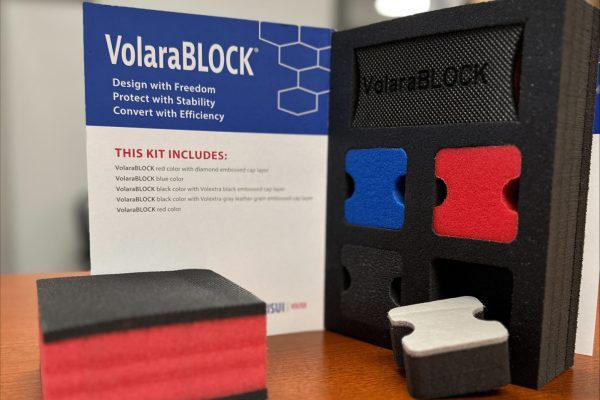
VolaraBLOCK™ gives converters and fabricators a unique advantage: the trusted performance of Volara® foam in a laminated block format up to 4 inches thick. Unlike bun foam, which can have variable properties throughout the bun, VolaraBLOCK™ is built by laminating multiple layers of consistent, physically cross-linked Volara® sheet — providing uniformity, control, and design flexibility.
Design Freedom Through Layered Construction
Because VolaraBLOCK™ is laminated, it opens up new creative possibilities for converters, including:
- Thicker, deeper components cut from a fully convertible block from top to bottom and side to side, maximizing throughput.
- Die-cut, routed, or waterjet-cut parts with substantial depth
- Multi-level or multi-step designs without stacking separate sheets
- The option to incorporate different colors in different layers for identification, orientation, branding, or visual cues inside complex parts
This layered format allows for clean, precise parts while reducing the need to bond multiple layers after cutting.
Uniformity You Can Count On
VolaraBLOCK™ maintains the fine, closed-cell structure and consistent mechanical performance that Volara® is known for. Each laminated layer contributes to:
- Reliable density
- Predictable cutting behavior
- Uniform performance throughout
Compared to bun foam, which can vary from the center to the edges, VolaraBLOCK™ supports tighter tolerances — ideal for seals, gaskets, medical components, packaging inserts, and EV/industrial parts.
Better Efficiency for Converters
Processing a thick laminated block can reduce:
- Assembly time
- Adhesive use
- Layer alignment issues
- Scrap from manually bonding sheets
It’s an efficient option that helps improve throughput and part consistency.
A Better Way to Build Thick, High-Performance Foam Parts
VolaraBLOCK™ combines the proven performance of Volara® with the versatility of a thick laminated format — giving converters and fabricators more control, more design options, and more efficiency than traditional bun foam.